
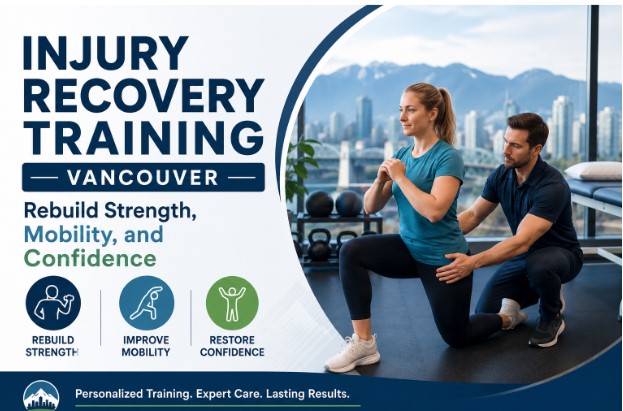
Recovering from an injury requires more than simply waiting for symptoms to disappear. Injury recovery training in Vancouver can help individuals progressively rebuild strength, mobility, stability, and functional movement after an injury or rehabilitation period.
A well-designed program bridges the gap between initial rehabilitation and returning to everyday activities, work, exercise, or sport. Training should be adapted to the individual’s injury, current abilities, medical guidance, and recovery goals.
What Is Injury Recovery Training?
Injury recovery training is a structured exercise approach designed to help people regain physical function after an injury.
Depending on the individual’s needs, a program may include:
- Strength exercises
- Mobility training
- Balance and stability work
- Core strengthening
- Functional movement exercises
- Flexibility training
- Progressive resistance training
- Sport-specific conditioning
The objective is to gradually restore physical capacity without progressing faster than the person’s recovery allows.
Who Can Benefit From Injury Recovery Training?
This type of training may be appropriate for individuals recovering from:
- Sports injuries
- Workplace injuries
- Motor vehicle injuries
- Muscle strains
- Joint injuries
- Tendon problems
- Post-surgical rehabilitation
- Back or neck injuries
- General movement limitations
The appropriate training approach depends on the injury and should be guided by qualified healthcare or rehabilitation professionals when necessary.
Benefits of Personalized Recovery Training
Rebuild Strength
Inactivity after an injury can lead to reduced muscle strength. Progressive resistance exercises can help restore the strength needed for everyday movement and physical activity.
Improve Mobility
Targeted mobility exercises can help restore comfortable joint movement and address stiffness that develops during periods of reduced activity.
Restore Stability and Balance
Balance and stability exercises can improve control and coordination around affected joints and movement patterns.
Improve Functional Movement
Functional exercises replicate movements used in everyday life, work, or sports, helping individuals gradually return to activities that matter to them.
Build Confidence
Returning to physical activity after an injury can be challenging. A gradual, supervised progression can help individuals become more comfortable with movement as their physical capacity improves.
What Happens During an Initial Assessment?
A personalized injury recovery program generally begins with an assessment.
Depending on the individual’s circumstances, this may include:
- Injury and activity history
- Functional movement assessment
- Strength testing
- Mobility evaluation
- Balance assessment
- Postural assessment
- Discussion of recovery goals
The information gathered helps determine an appropriate starting point and progression.
The Stages of Injury Recovery Training
Every recovery plan is different, but progression may broadly involve several stages.
1. Restore Basic Movement
Early training may focus on comfortable movement, mobility, and foundational exercises appropriate to the injury.
2. Rebuild Strength
Resistance exercises can progressively challenge weakened muscles and improve physical capacity.
3. Improve Stability and Coordination
Balance and movement-control exercises can prepare the body for more demanding activities.
4. Increase Functional Capacity
Exercises become progressively more similar to the activities required for work, daily life, or sport.
5. Return to Activity
The final stage may involve more advanced conditioning and activity-specific exercises, provided the individual is appropriately cleared to progress.
How Personal Training Can Support Recovery
A personal trainer can provide structure and accountability during the later stages of recovery. Training may focus on rebuilding general fitness and strength while respecting recommendations provided by rehabilitation or healthcare professionals.
For individuals with complex injuries, collaboration between the trainer and healthcare team can help ensure that exercise progression remains appropriate.
Tips for a Successful Recovery
To support your recovery:
- Follow your healthcare professional’s recommendations.
- Progress gradually rather than rushing to heavier exercise.
- Perform prescribed exercises consistently.
- Prioritize proper technique.
- Allow sufficient recovery between sessions.
- Communicate changes in pain or function promptly.
- Maintain adequate sleep, nutrition, and hydration.
Recovery is rarely perfectly linear, so programs may need to be adjusted over time.
Frequently Asked Questions
What is injury recovery training?
It is a structured exercise approach that helps individuals progressively rebuild strength, mobility, stability, and functional capacity after an injury.
Can personal training replace rehabilitation?
Not necessarily. Personal training and clinical rehabilitation serve different purposes. Individuals with an active injury or medical condition should follow appropriate professional guidance before beginning or progressing exercise.
How long does injury recovery training take?
Recovery time varies significantly depending on the type and severity of the injury, treatment received, individual health, and rehabilitation goals.
Can injury recovery training help someone return to sports?
Yes. Once appropriately cleared, progressive strength, conditioning, and sport-specific exercises can help bridge the gap between rehabilitation and full athletic participation.
Conclusion
Injury recovery training in Vancouver can provide a structured pathway from rehabilitation toward restored strength, mobility, and everyday function. A personalized approach allows exercise to progress according to the individual’s capabilities rather than relying on a one-size-fits-all routine.
Whether you’re rebuilding strength after an injury, returning to work, or preparing to resume sport, working with qualified professionals and progressing gradually can help create a safer and more sustainable return to activity.